Sign In

  • Forgot your password?
  • Need a new account?

Register


NIR objective lens

NIR objective lens
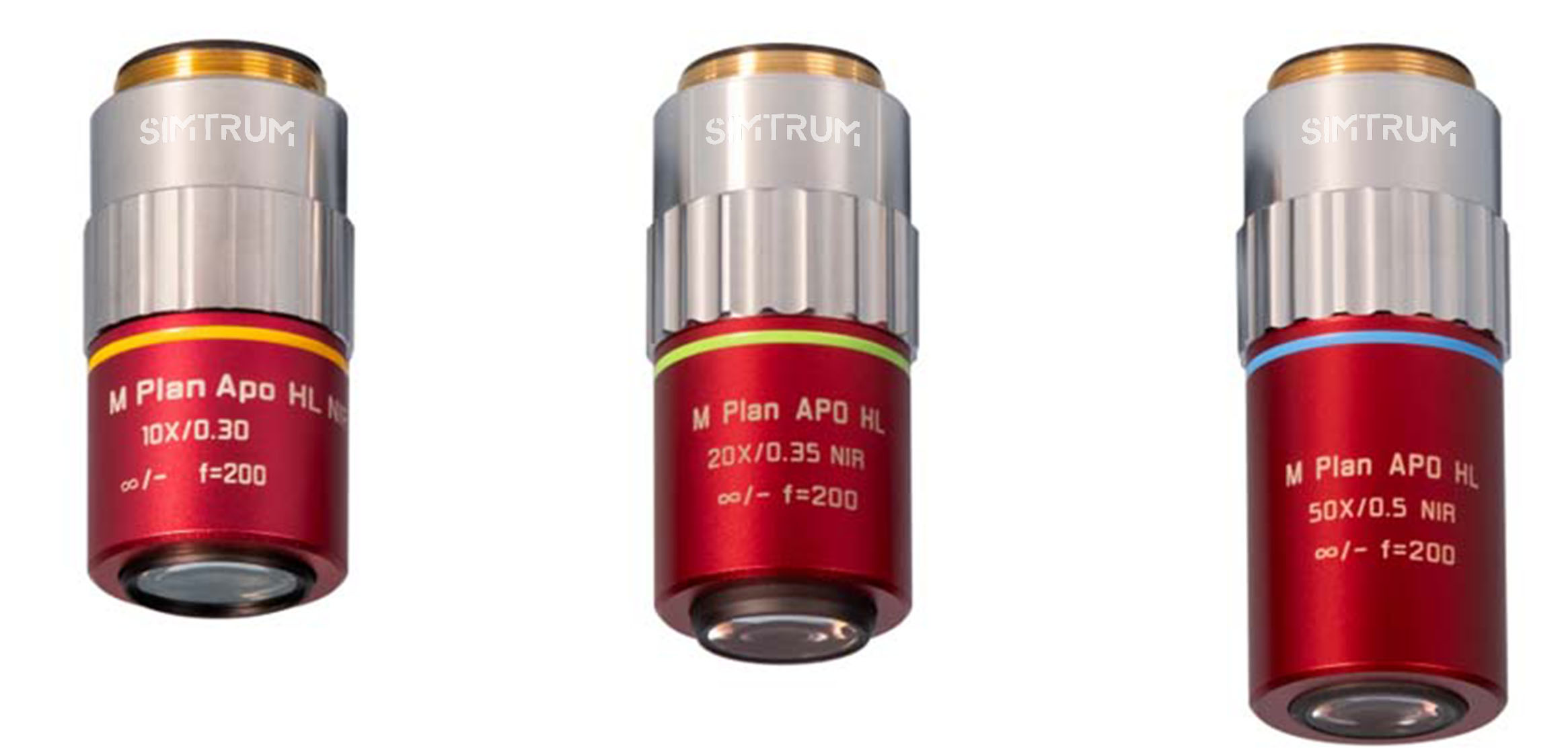
NIR objectives are microscope objectives designed and optimized by SIMTRUM for near-infrared (NIR) wavelengths. These objectives utilize special broadband multilayer anti-reflection coatings to ensure exceptionally high transmission from the visible to the near-infrared range, thereby maintaining image brightness and a high signal-to-noise ratio. At the same time, they provide chromatic aberration correction at the semi-apochromatic level.
 

Dimensions


Items CXF2009NIR010 CXF2009NIR020 CXF2009NIR050 CXF200ML100A NIR
Optical System Infinity-corrected Infinity-corrected Infinity-corrected Infinity-corrected
Observation Method Brightfield Brightfield Brightfield Brightfield
Chromatic Aberration Correction Semi-apochromatic Semi-apochromatic Semi-apochromatic Semi-apochromatic
Magnification [X] 10X 20X 50X 100X
Focal Length [mm] 20 10 4 2
Field Number [mm] 25 25 25 25
Numerical Aperture (NA) 0.3 0.35 0.5 0.8
Entrance Pupil Diameter [mm] 12 7 4 3.2
Working Distance (WD) [mm] 33 27 16 3.01
Depth of Focus (μm) 6.1 4.5 2.2 0.85
Depth of Field (μm) 15 7.2 2.5 0.9
Resolution (μm) 1 0.96 0.67 0.42
Cover Glass Thickness [mm] - - - -
Spring Protection - - - -
Parfocal Distance [mm] 95 95 95 45
Thread M26X1/36” M26X1/36” M26X1/36” M26X1/36”
The resolution and depth of focus of the objectives are calculated based on a reference wavelength (λ=550nm) 550 550 550 550

Our NIR objectives are particularly well suited for the following applications:

  • Deep tissue imaging
  • Multiphoton microscopy
  • Semiconductor inspection and failure analysis

NIR objectives use broadband multilayer anti-reflection coatings to reduce reflectance to extremely low levels, minimizing losses in the near-infrared region. In conventional objectives, lens elements inevitably absorb NIR light and convert it into heat, and the resulting temperature changes cause slight variations in lens spacing and curvature. In contrast, NIR objectives employ low–thermal-expansion materials along with active/passive thermal stabilization designs to minimize the effects of temperature fluctuations.

Thanks to their high transmittance, high numerical aperture, and semi-apochromatic correction, NIR objectives are exceptionally well suited for multiphoton microscopy.


Q: How should I choose the appropriate numerical aperture (NA)?
A: Numerical aperture primarily affects resolution, light-collection efficiency, and working distance. Higher NA provides higher resolution and stronger light-gathering capability (leading to brighter images), but it also results in a shorter working distance, shallower depth of field, and higher cost.


We are here for you!


Drop us an email at info@simtrum.com to get the Best Price today.   Want more technical information?
 Click Here for the professional Customized System/ Solutions.


Don't have time to search the products one by one? No worries.
you can download the full range of SIMTRUM Product Line Cards.
Click it now.


Want to stay closer to the Market Dynamics and Technological Developments? Just take 5 seconds to Sign In as a member of SIMTRUM,
we will bring you the most up-to-date news. 
(Sign in button on the top right of the screen).


Search Reset
Compare Model Drawings & Specs Availability Reference Price
(USD)

Accessories

Compare Model Drawings & Specs Availability Reference Price
(USD)